Workforce Management Software in Australia: The Complete 2026 Guide
Workforce Management Software in Australia: The Complete 2026 Guide
It’s Tuesday afternoon. A duty manager is finalising next week’s roster in a spreadsheet when two problems slip through. She’s scheduled a team member to finish at 11pm and start again at 7am, breaching the 10-hour minimum break under their Modern Award.
And one of her casuals is about to cross the hours that should trigger an offer of casual conversion under the Closing Loopholes No. 2 Act 2024.
Neither shows up in red text. The roster goes out, the breaches go live, and the only thing standing between the business and a Fair Work Ombudsman complaint is whoever notices first.
Across Australia, managers lose hours every week to manual rostering, chasing timesheets and interpreting award rules in their heads.
Modern workforce management software addresses this in three connected ways:
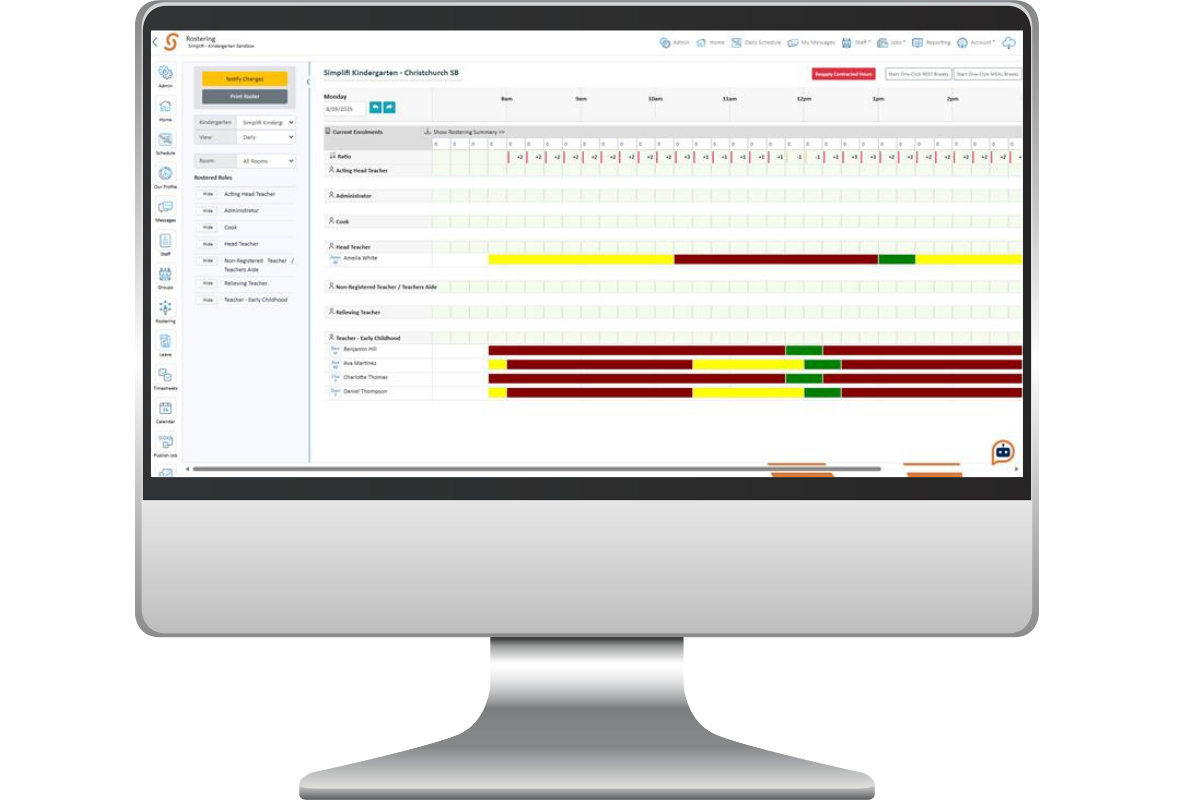
- Intelligent rostering that builds fair, accurate schedules from skills, availability and demand
- Comprehensive timesheets that capture attendance cleanly and route approvals through a single workflow
- An awards-aware payroll rules engine that calculates penalty rates, allowances, overtime and break entitlements before clean data flows to payroll.
This 2026 guide to workforce management software in Australia walks through the features that matter, the benefits Australian operators are seeing and how to choose a platform that holds up under Fair Work, Modern Awards and STP Phase 2.
What is Workforce Management Software?
Workforce management software is an integrated platform that helps Australian organisations plan, track and optimise their workforce, from the first roster draft through to the final payslip.
A modern WFM system pulls together what used to live in five spreadsheets and three inboxes:
- Intelligent rostering with visibility of skills, availability and demand
- Time and attendance via mobile or fixed terminals
- Leave management aligned to the National Employment Standards (NES)
- Compliance monitoring that checks every shift against the relevant Modern Award
- An awards-aware payroll rules engine that interprets penalty rates, overtime, allowances and casual loadings
- Reporting that turns workforce data into insight.
Today’s workforce management system is a proactive platform that helps Australian employers stay on the right side of the Fair Work Act 2009, manage their obligations under STP Phase 2 and respond sensibly to newer obligations.
Nucleus Research reports that workforce management solutions return $12.24 for every dollar spent, driven by reduced scheduling time, fewer payroll errors and a stronger compliance posture.
Key Features Every WFM Solution Should Include For Australian Businesses
When you’re evaluating workforce management software australia options, certain capabilities are non-negotiable.
For Australian organisations, compliance features deserve close attention. The Fair Work Act 2009, the National Employment Standards and 122 Modern Awards administered by the Fair Work Commission set obligations around minimum rest periods, overtime, penalty rates, public holidays, casual loadings and leave.
Layered on top, ATO Single Touch Payroll Phase 2 requires granular reporting of income types, leave categories and employment basis every pay run, so the data your platform passes to payroll has to be clean, classified and complete.
Good wfm software automates these obligations rather than just providing a screen where someone records them manually. Simplifi’s staff rostering and payroll rules engine have Modern Award interpretation embedded, not bolted on.
The Business Benefits of Implementing WFM Software in Australia
Time Savings
Manual rostering and time tracking are quiet productivity killers. Nucleus Research’s $12.24-per-dollar return is largely driven by the hours managers reclaim once they stop rebuilding rosters and chasing paper timesheets.
For a manager spending 10 hours a week on workforce admin, that’s roughly 7.5 hours back (time that goes into coaching, customer experience and planning).
Cost Reduction
Labour typically accounts for 50–70% of operating costs in service-based Australian businesses, so small inefficiencies compound quickly.
A good workforce management system reduces costs by eliminating overstaffing through demand-based rostering, preventing buddy punching, reducing unplanned overtime and minimising compliance breaches.
The Productivity Commission has consistently identified workforce scheduling and back-office automation as material levers for service-sector productivity, and ABS Labour Force data shows how thin margins are in shift-based industries. A 5–10% reduction in unplanned overtime in a business with $2 million in annual labour cost is six-figure money, before counting the compliance upside.
Compliance Confidence
This is where the case for workforce management software is strongest in Australia, and where 2025 changed the landscape. The Australian compliance stack is now:
- The Fair Work Act 2009, with the Fair Work Ombudsman as regulator and the Fair Work Commission as tribunal
- The National Employment Standards (11 minimum employment conditions)
- 122 Modern Awards setting industry or occupation-specific minimum pay, penalty rates, allowances and conditions
- ATO Single Touch Payroll Phase 2, with granular real-time reporting every pay event
- The Closing Loopholes No. 2 Act 2024, which introduced wage theft criminalisation from 1 January 2025 (making intentional underpayment a federal criminal offence) and updated the casual conversion pathway (see the Attorney-General’s Department overview)
- The Right to Disconnect, applying to non-small business employers from 26 August 2024 and small business employers from 26 August 2025.
A WFM platform supports this stack by:
- Holding time-stamped records of every shift, break and approval
- Interpreting Modern Awards at the point of rostering
- Tracking casual hours so conversion offers can be triggered when thresholds are reached
- Producing the granular data STP Phase 2 needs
- Maintaining audit trails that move you from “we think we’re compliant” to “we can demonstrate we are.”
A platform that can produce the records, the award logic and the audit trail in minutes is now a governance asset, not just an operations tool.
Employee Satisfaction
A modern WFM system enables equitable shift distribution, advance schedule visibility, easy shift swaps, self-service leave management and clear communication when shifts change.
The Right to Disconnect formalised an expectation that already existed culturally: employees should not be routinely contacted outside paid hours. A platform that publishes shifts well in advance and routes changes through controlled workflows is a practical answer.
Data-Driven Decision Making
Real-time dashboards mean labour cost against budget is visible during the period, not at month-end. Productivity trends are identifiable across teams and sites, forecasts are grounded in historical data and site performance can be benchmarked side by side. This shifts workforce management from reactive firefighting to proactive optimisation.
Industries That Benefit Most: An AU View
Healthcare and Aged Care
Aged care and healthcare carry some of the most complex workforce requirements: 24/7 operations, mandatory ratios, credentialing, the Strengthened Aged Care Quality Standards, and care minutes and 24/7 RN obligations.
Payroll interpretation is governed primarily by the Aged Care Award 2010, the SCHADS Award (community and in-home providers) and the Nurses Award 2020. AIHW workforce data shows the sector running tight, with significant casual and agency reliance.
Hospitality
Hospitality operates on extreme demand variability with predominantly casual workforces, split shifts and complex award interpretation.
The Hospitality Industry General Award 2020 sets penalty rates, allowances, minimum breaks and overtime. Getting it wrong at scale is exactly the pattern wage theft criminalisation now treats seriously.
Retail
Retail shares hospitality’s demand variability and adds multi-site complexity and peak trading periods (Christmas, EOFY, Boxing Day).
The General Retail Industry Award 2020 governs penalty rates, public holiday rules and casual loadings, all of which a good rostering software australia platform should interpret automatically.
Early Childhood Education
Early childhood education operates under the National Quality Framework administered by ACECQA, with strict educator-to-child ratios and qualification requirements.
Payroll interpretation sits primarily under the Children’s Services Award 2010. WFM software helps centres maintain ratio compliance, track qualifications and visualise costs across budget centres.
Trade and Labour
Trade and labour operations coordinate mobile workforces across multiple sites and manage site-specific safety and induction requirements. Payroll interpretation is typically anchored on the Building and Construction General On-site Award 2020.
A mobile-first time and attendance workflow is essential. Paper dockets won’t cut it under STP Phase 2.
Any Australian organisation with 20+ employees managing shift-based work, Modern Award obligations or material labour cost pressure will see significant value.
How to Choose the Right WFM Software for your Australian Organisation
Step 1: Audit your Pain Points
Look honestly at how rostering, timesheets, leave, compliance and payroll happen today. Estimate the hours each consumes and note recurring problems (award misinterpretation, coverage gaps, payroll corrections). This baseline lets you prioritise features and measure improvement.
Step 2: Define Must-Have Requirements
Identify what’s essential: industry-specific tools, integrations, mobile support, multi-site capability and award coverage.
For Australian organisations, ensure the platform understands Modern Awards, NES, STP Phase 2 reporting and current AU compliance changes, including wage theft criminalisation and the Right to Disconnect. Generic overseas platforms often fall short here.
Step 3: Evaluate Vendor Capabilities
Assess Australian compliance coverage, usability, support quality, industry references and total cost of ownership.
Step 4: Consider Total Cost of Ownership
Look beyond the subscription price. Include implementation, training, integrations and per-user fees. Most organisations recover the investment within 12–18 months.
Step 5: Demo with Real Scenarios
Ask each vendor to model a tricky split shift, a public holiday with penalty rates, a casual approaching conversion thresholds and a leave request that crosses a pay period.
Implementation Best Practices and Common Pitfalls
Best Practices
- Build the executive ROI case explicitly (time, cost, compliance, risk)
- Appoint internal champions
- Clean roster and leave data before migration
- Train with role-specific scenarios
- Pilot in one site, refine, then scale.
Pitfalls
- Rushing implementation
- Skimping on training
- Choosing on price alone
- Ignoring payroll integration requirements
- Failing to configure award rules properly.
Typical implementations run 4–12 weeks.
Future Trends in Workforce Management Technology
AI-Powered Scheduling
Industry analysts have reported that around 70% of large enterprises are now deploying AI-based staff scheduling, with AI-assisted systems cutting up to 140 hours of manual scheduling time annually for managers.
Advanced Analytics
Next-generation platforms deliver turnover risk alerts, staffing forecasts, labour-cost predictions and skills-gap analysis grounded in your own data.
Mobile Experiences and Integration Ecosystems
Mobile-first design is now the baseline. Modern WFM platforms are built API-first for clean data exchange across payroll, HR and finance (exactly what STP Phase 2 requires).
Focus on Employee Experience
Schedule fairness, transparency and respect for non-working time directly affect retention. The Right to Disconnect has formalised what good operators already practised.
Gartner predicts that by 2028, more than 20% of digital workplace tools will use AI-driven personalisation to create adaptive, employee-centred experiences.
Frequently Asked Questions
What’s the difference between WFM software and an HRIS?
An HRIS manages the employee lifecycle (recruitment through offboarding), while a workforce management system handles operations (rostering, time and attendance, leave, award interpretation and the data flow into payroll). Most Australian businesses use both, with integration between them.
How much does workforce management software typically cost?
Cloud-based platforms typically cost AUD $4–12 per employee per month, with implementation from AUD $2,000 to $20,000 depending on size and complexity.
How long does WFM software implementation take?
Usually 4–12 weeks, depending on organisation size, number of sites and Modern Award configuration complexity.
Will WFM software integrate with our existing payroll system?
Most modern platforms integrate with the major Australian payroll systems. STP Phase 2 makes clean integration more important, not less (granular leave, income-type and employment basis data has to flow through accurately).
Do we need WFM software if we’re a small business?
Often yes. Complexity matters more than headcount. A 25-person hospitality venue with casuals, split shifts and public holiday penalty rates has more award complexity than a 200-person office team. The Right to Disconnect applies to small business employers from 26 August 2025, adding another reason to formalise scheduling.
How does WFM software help with Fair Work and Modern Award compliance?
A good platform interprets the relevant Modern Award at the point of rostering (flagging minimum breaks, maximum hours, penalty rates and allowances before a shift is published) and maintains time-stamped records of hours worked and approvals given. That combination gives you preventative compliance plus the audit trail you’d need in a Fair Work Ombudsman investigation.
What does Single Touch Payroll Phase 2 mean for rostering and timesheet data? STP Phase 2 expects granular reporting per pay event: disaggregated gross income types (overtime, allowances, paid leave by category), employment basis and tax treatment codes. That data usually originates upstream in rostering and time and attendance.
A WFM system that classifies hours and leave correctly upstream makes Phase 2 reporting drama-free.
Does WFM software handle the Right to Disconnect and Closing Loopholes casual conversion rules?
The better platforms do. For the Right to Disconnect, that means publishing rosters in advance, routing late changes through controlled workflows and recording communications inside the platform rather than via late-night texts.
For casual conversion, that means tracking each casual’s hours and pattern of work against the relevant thresholds and prompting an offer when triggers are reached.
Key Takeaways
Modern workforce management software in Australia:
- Saves 50–75% of time spent on manual rostering and admin
- Reduces labour costs through optimised rostering, fewer overtime surprises and tighter controls
- Builds compliance confidence against the Fair Work Act, NES, 122 Modern Awards, STP Phase 2, wage theft criminalisation and the Right to Disconnect
- Improves employee satisfaction through fair, transparent, predictable scheduling
- Delivers the data leaders need to make workforce decisions strategically rather than reactively.
Ready to Get Started?
Australian employers are operating under a more demanding compliance regime than they were two years ago. Wage theft is now criminal and STP Phase 2 expects cleaner, more granular data every pay run. The Right to Disconnect has applied across the board since 26 August 2025.
The right workforce management software platform turns these obligations from a source of anxiety into a managed, evidence-backed part of how your business runs.
Simplifi was purpose-built for the AU and NZ markets, with Modern Award interpretation, time and attendance, leave, compliance and payroll integration in one platform.
Want to see how it would handle your roster, your award and your edge cases? Book a demonstration or contact our team.